Introduction
The muscular system is the engine behind every movement in the human body, operating through a specialized network of over 600 muscles that transform chemical energy into mechanical force. For voluntary actions like sprinting and lifting, or sustaining vital involuntary processes like the beating of the heart and the rhythmic digestion of food, muscles rely on a fundamental principle: contraction. The muscular system not only enables motion and structural stability, but also plays a critical role in maintaining posture, joint integrity, and core body temperature.
Features of the Muscular System
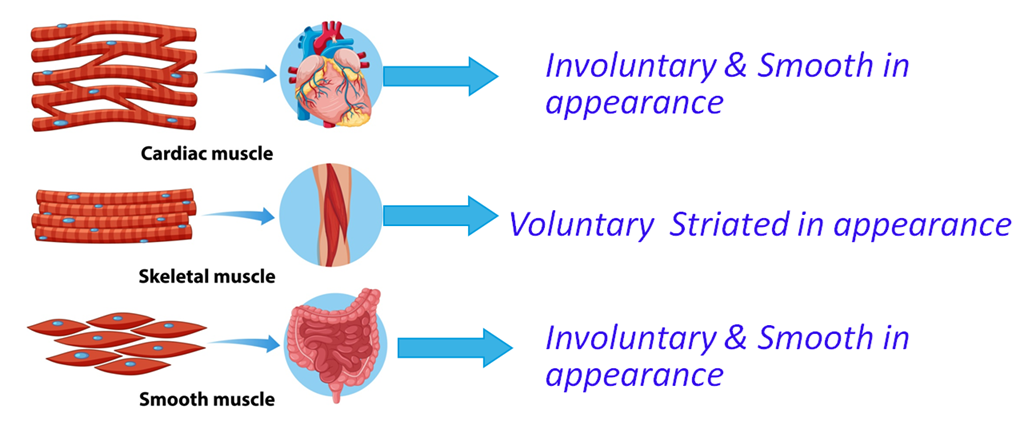
- The muscular system forms around 40- 50% of the body mass and primarily contains three types of muscles depending on their structure, function, and shape.
- The primary function of the muscular system is contraction. By contracting and relaxing, they allow a wide range of movement of the different parts of the body and its organs. This maintains all physiological functions essential for living, like breathing, digestion, etc.
- All body muscles work together to maintain posture and stability.
- They support the skeleton and prevent the body from collapsing under weight and help movement in activities.
- Temperature Regulation: As muscles work, they generate heat, that keeps our body warm.
- Protecting Internal Organs: Smooth muscles within the walls of organs serve as a layer of insulation for the internal organs, protecting them from damage and shock.
- Cardiac muscles work involuntarily to pump blood to all regions of the body, which is necessary for survival.
3 Types of Muscular System
The 3 types of muscular system are: –
1. Skeletal Muscle- Attaches to the bones via tendons and contracts to move bones
2. Smooth Muscle- Found on the walls of organs and tubes (stomach and blood vessels)
3. Cardiac Muscle-Forms the walls of the heart.
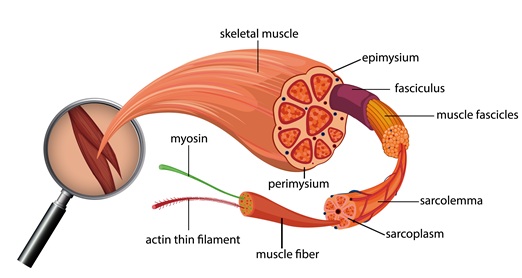
MUSCLE FIBRE ANATOMY
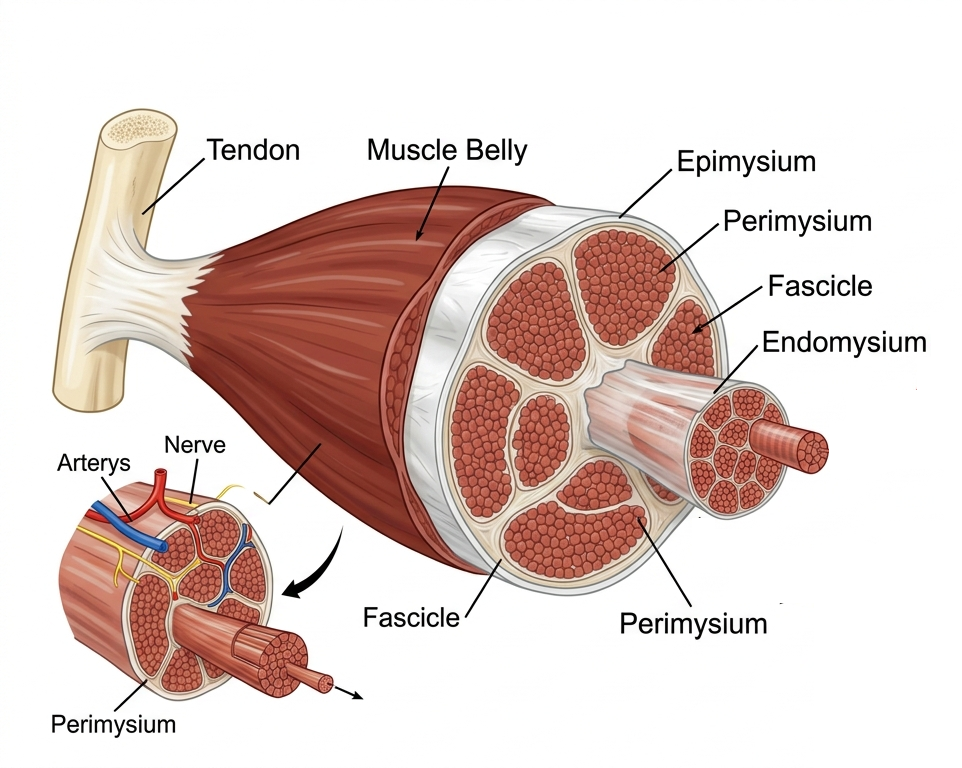
- Skeletal Muscle are made up of many muscle fibres that are held in one place by a connective tissue called fascia.
- Muscle fibres are made up of myo-fibrils ( protein filaments) composed of a series of repeating segments called sarcomeres.
- Sarcomere: Formed of thick myosin and thin actin myofilaments. Sarcomere is the functional contracting unit of skeletal muscle.
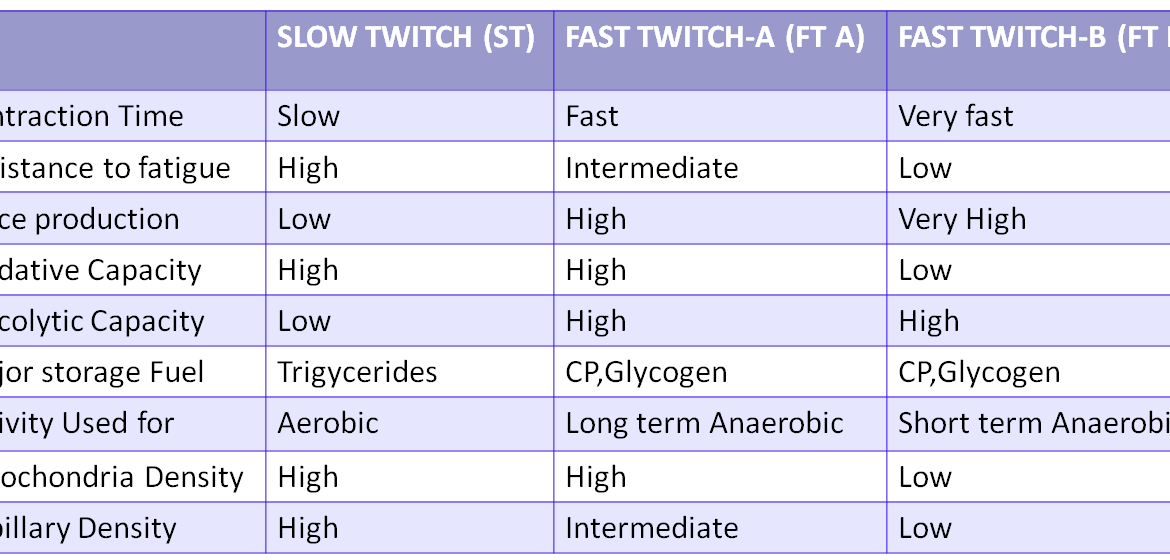
- Type I (Slow Twitch) and Type II (Fast Twitch) muscle Fibres.
INTERNAL STRUCTURE OF MUSCLE
Skeletal muscle fibers are made up of endomysium, perimysium, and epimysium, covering the sarcolemma; each muscle fiber is a layer of connective tissue called the endomysium. Capillaries and nerve tissue are present within the endomysium to supply the individual muscle fibers.
Multiple muscle fibers join to form fascicles encased by another connective tissue covering known as the perimysium.
The perimysium may surround anywhere from 10 to 100 fascicles. Muscle fascicles are further grouped to form a muscle encased by a fibrous tissue envelope called the epimysium.
Each muscle fiber is composed of several hundred to several thousand myofibrils.
Myofibrils are composed of actin (thin filaments), myosin (thick filaments), and support proteins. The arrangement of actin and myosin gives skeletal muscle its microscopic striated appearance and creates functional units called sarcomeres.
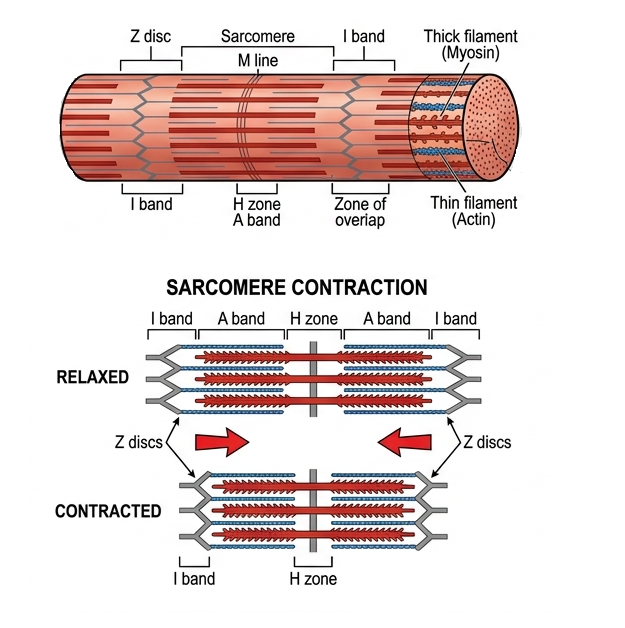
STRUCTURE OF MYOFIBRIL
- The myofibril is a basic rod-like unit of the muscle cell. Myofibrils are composed of repeating contractile units known as sarcomeres.
- The myofibrils are mainly composed of many long proteins such as myosin and actin that hold them together. All these proteins are organized into thick and thin filaments which are called myofilaments.
- The contraction of muscles happens when there is sliding between the thick (myosin)and thin (actin) filaments along with each other.
Characteristics of 3 Muscle Fibre Types
MUSCLE CONTRACTION
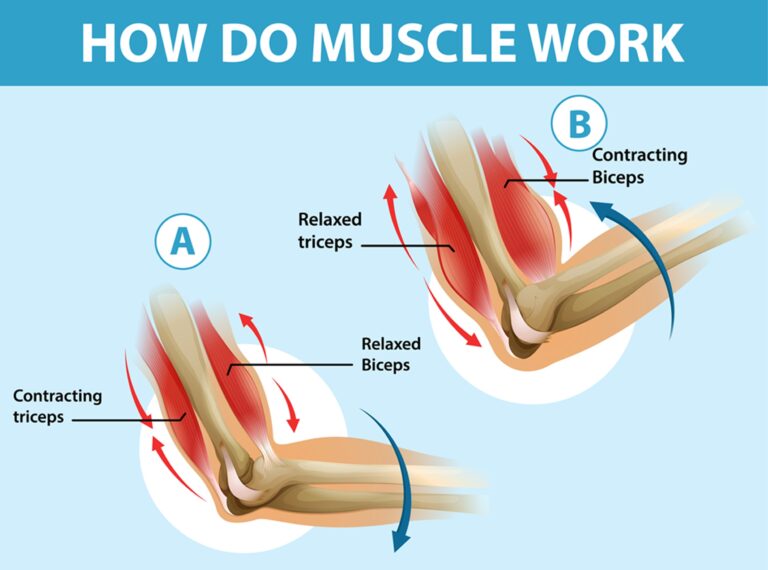
- Isotonic muscle Contraction: Isotonic contractions generate force by changing the length of the muscle and can be concentric contractions or eccentric contractions, although the tension developed is constant.
- Concentric Contraction: Type of muscle contraction that results in shortening of the muscles when tension is created. It generates enough force to move an object. For example, when lifting a heavy weight, a concentric contraction of the biceps would cause bending at the elbow, lifting the weight upwards.
- Eccentric Contraction: Type of muscle contraction that causes lengthening of muscle fibre as the resistance/load becomes greater than the force produced by muscle.
- Isometric muscle Contraction: Tension is created but there is no change in length of muscle fibre. Maximal isometric tension can be exerted when the sarcomeres are at their resting length because the actin and myosin filaments overlap during their entire length and the number of cross bridges is maximal.
The muscle contraction required to hold but not move a heavy weight would be isometric. In this case the muscles do not change length, and joints are not moved, so force for grip is sufficient. When the muscles of the hand and forearm grip an object; the joints of the hand do not move, but muscles generate sufficient force to prevent the object from being dropped.