

Working out too intensely over a prolonged period of time may cause the risk of burnout and injury. But for achieving visible muscle growth and strength , working out hard enough is required. That’s where the reps in reserve, or RIR, method comes in.
RIR is an effort-based training method that is changing how people—from beginners to elite athletes—approach strength training. Fitness creators across social media have also highlighted its benefits. One creator explains that RIR helps account for how you feel on any given day, allowing you to train at the most appropriate intensity. On a strong day you may lift a bit more than expected, on an off day you may lift a little less—but either way you train at the right level for the day. Fitness experts claim that using RIR can lead to better workout intensity and consistency and also help in improving muscular strength.


For example, if you finish a set and feel like you could’ve done two more reps before hitting failure, you were at 2 reps in reserve.
RPE stands for Rate of Perceived Exertion. It is a scale used to measure how hard an exercise or workout feels based on your level of effort and fatigue.
In strength training, the most common version uses a 1–10 scale:
RPE is closely related to RIR (Reps In Reserve):
For example:
“Bench press: 3 sets of 5 at RPE 8” means:
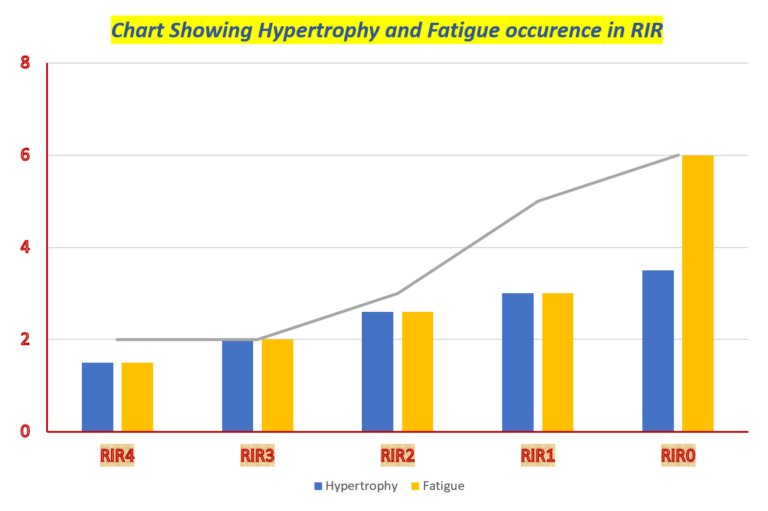
RIR is useful because it renders enough effort to drive results without creating unnecessary fatigue.
The closer one trains towards failure, the lower is his RIR count leading to stronger training stimulus along with more fatigue that the set will generate.
Helps Reduce Risk of Injury
You can better manage muscle fatigue using RIR. Muscle recovery is affected and becomes inefficient by pushing every set till failure. This can impact performance in the later sessions.
It Tailors Your Training to You
There’s a lot of opinion about lifting heavy in small rep ranges to build muscles. But that advice does not always applies to the general population in a practical way.
Lifting heavy in smaller repetition ranges can lead to injury. The RIR model is more tailored to meet the needs of individuals where they are at in their fitness journey versus assigning a specific rep range to build muscle. Muscle can be built across a wide range, from 1 to 30 reps, so RIR allows individuals to choose weights that fit their fitness level—and might feel less intimidating.
Builds Muscle Strength and Size
Using RIR can help target different muscle groups based on your goals but is most effective with proper diet and recovery routines.
For strength, driving the workout till failure is not necessary. A range of 2 to 4 RIR allows to maintain speed, technique, and overall training quality especially for compound lifts (exercises that engage multiple joints and muscle groups at the same time). For muscle hypertrophy, one needs to work near failure, and a range of about 0 to 3 RIR is good enough to attain hypertrophy.
Attaining 0 RIR in every set is usually not necessary and often increases fatigue more than it improves results.”
RIR is useful because it renders enough effort to drive results without creating unnecessary fatigue.
It Helps to be Consistent
This methodology can improve long-term consistency in the gym. Maintaining a working set within 2 to 3 RIR, allows us to train close to failure to build muscle without complete exhaustion and fatigue leading to better recovery and workout continuity. Excessive fatigue can require more recovery time and make it harder to be consistent or stick to a program.