


Plyometric exercises are described as any movement involving the SSC and the movement concerned requires maximum or sub-maximal efforts. Exercises like hops and jumps are utilized in a co-ordinated mode by athletes for performance improvement as a part of their plyometric training program. Some of the most popular plyometric exercises include jump squats, skaters, tuck jumps, depth jumps, and box or platform jumps, and these exercises improve exercise performance.
Although many may think that plyometrics are mainly for the lower body, but plyo movements that target the upper body, such as plyo push-ups or medicine ball slams against a wall, helps to throw with greater force and increases the velocity with which the trainee throws a ball or swing a racket. This helps in performance improvement in sports like baseball, tennis, or any sport that requires throwing.
Plyometrics and stretch-shortening cycle are synonymously used by many. However, this form of exercise has found application not only in athletic performance enhancement but also in rehabilitation and conditioning programs. The application of plyometrics has evolved over the years and today it is used at submaximal effort levels to restore biomechanical functionality and injury prevention in sports.
The eccentric phase involves rapid muscle lengthening and is the pre-stretch phase of a plyometric exercise. During the pre-stretch, your muscles and tendons store energy they will eventually release in the third phase of a plyometric movement.
This phase is also called the loading phase where the muscle-tendon unit of the synergistic muscle group are stretched as a result of the kinetic energy or loading applied to the joint. The eccentric pre‐stretch phase of a plyometric activity stretches the muscle spindle of the muscle‐tendon unit and the non‐contractile tissue within the muscle. This pre‐stretch enhances the resultant concentric muscle contraction. The pre‐stretch phase is dependent on three stretch variables: magnitude of the stretch, rate of the stretch, and duration of the stretch. These variables can be optimized for effective energy storage during the eccentric pre‐stretch motion.
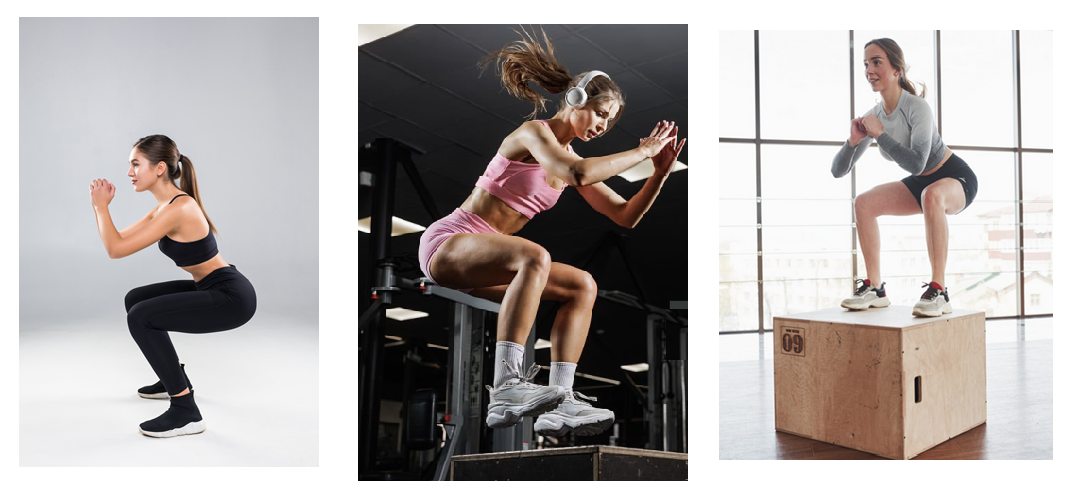
The amortization phase is the stabilization phase where the stored energy in the eccentric phase is waiting to be released. But prolonged amortization phase leads to delaying of the release of stored energy thereby causing the muscle to lose some of its potential energy, reducing the generated explosive force.
This phase is the key to the performance of plyometrics, because the shorter the amortization phase the more powerful is the plyometric movement because of efficient use of the stored energy. If the amortization phase is delayed, the stretch reflex is not activated and the resultant concentric contraction is not as effective.
The concentric phase is the phase where the stored energy generated during the eccentric phase and stabilized during the amortization phase is released at the final action.
That’s how a basketball player can jump so high into the air; they’re releasing stored energy explosively. The amount of energy released depends on how much was initially stored during the eccentric phase.
This varies with how fast the muscle is stretched, the magnitude of the stretch, and duration of holding the stretch. This final phase of the plyometric movement results from many interactions including the biomechanical response that utilizes the elastic properties of the pre‐stretched muscles.
The blending of these three phases lead to perform a plyometric movement is used to enhance the muscle’s power performance.